
Tau-neurodegeneration mismatch reveals vulnerability and resilience in Alzheimer's

In Alzheimer’s disease (AD), the relationship between tau tangles (T) and neurodegeneration (N) varies from patient to patient. Neurodegeneration is not specific to AD, and it is shaped by co-pathologies, aging and resilience factors.
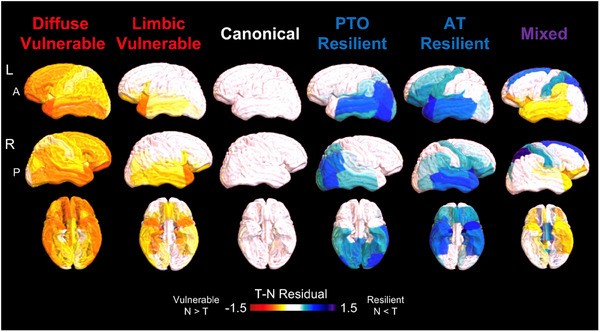
In Alzheimer’s & Dementia, Xueying Lyu, Sandhitsu Das and colleagues used regional patterns of T-N residuals (how much more or less atrophy a region shows than its tau level predicts) to divide 184 patients on the Alzheimer’s continuum into data-driven groups. They compared these with groups from 159 amyloid-negative patients defined by cortical thickness, and with 98 patients who had MRI during life and tissue measures of tau after death. The model was then applied to an independent cohort of 71 patients.
Key findings:
- The T-N mismatch patterns in AD groups resembled the neurodegeneration patterns seen in non-AD groups, were associated with similar non-AD factors, and came with diverging cognitive outcomes.
- In the autopsy cohort, limbic T-N mismatch correlated with TDP-43 co-pathology.
T-N mismatch may offer a personalized way to identify the non-AD factors behind vulnerability or resilience in individual patients.
Other PICSL contributors include Long Xie, Robin de Flores, Laura Wisse and Paul Yushkevich.
Reference: Lyu X, Duong MT, Xie L, et al., Yushkevich PA, Wolk DA, Das SR. Tau-neurodegeneration mismatch reveals vulnerability and resilience to comorbidities in Alzheimer’s continuum. Alzheimer’s & Dementia. 2024. doi:10.1002/alz.13559