
Plasma and MRI reveal vulnerable and resilient Alzheimer's phenotypes

In Alzheimer’s disease (AD), tau pathology (T) and neurodegeneration (N) usually go together, but not always. Earlier work from this group showed that a mismatch between the two can reveal contributions from other, non-AD processes. The medial temporal lobe (MTL) is an early site of AD, and also a frequent target of co-pathologies such as limbic-predominant age-related TDP-43 encephalopathy (LATE).
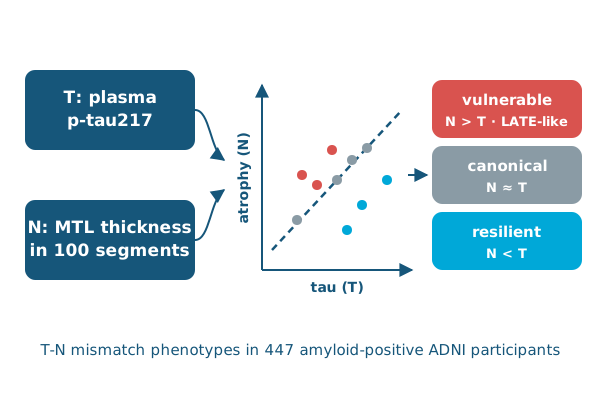
In a study in Brain, Xueying Lyu, Sandhitsu Das, David Wolk and colleagues measured T-N mismatch within the MTL using two widely accessible measures: plasma p-tau217 for tau, and MTL thickness in 100 segments for neurodegeneration. Clustering 447 amyloid-positive ADNI participants by their mismatch profiles produced three groups with comparable AD severity:
- Canonical (N ≈ T): AD-like patterns of neurodegeneration.
- Vulnerable (N > T): atrophy concentrated in the anterior MTL and extending into temporal-limbic regions, neurodegeneration that preceded estimated tau onset, and faster cognitive decline. This matches the profile of mixed LATE and AD.
- Resilient (N < T): minimal atrophy and preserved cognition.
The phenotypes replicated in an independent cohort. In a feasibility study, the model also identified vulnerable, LATE-like patients among 50 people receiving the anti-amyloid therapy lecanemab, pointing to a cost-effective way to stratify patients for clinical trials and precision medicine.
Other PICSL contributors include Nidhi Mundada, Emily McGrew, Long Xie, Yue Li, Philip Cook, Jim Gee, Laura Wisse and Paul Yushkevich.
Reference: Lyu X, Mundada NS, Brown CA, et al., Yushkevich PA, Das SR, Wolk DA. Medial temporal lobe tau-neurodegeneration mismatch from structural imaging and plasma biomarkers. Brain. 2026. doi:10.1093/brain/awag105