
Mapping the network architecture of the medial temporal lobe at 7T

The subregions of the medial temporal lobe (MTL) play key roles in memory and are affected differently by various neurological and psychiatric disorders. Characterizing their structure and function could help in understanding MTL physiology and diagnosing disease.
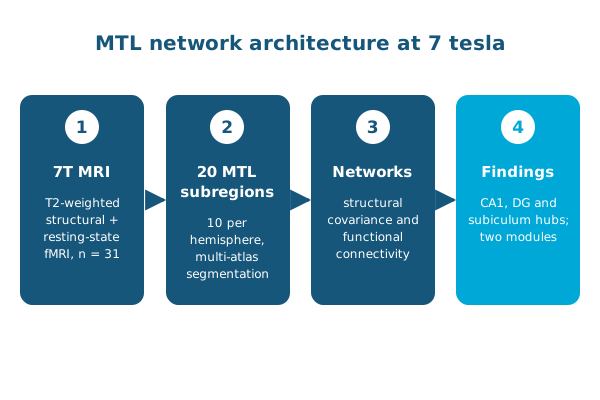
In Human Brain Mapping, Preya Shah, Laura Wisse, Paul Yushkevich, Kathryn Davis, Sandhitsu Das and colleagues characterized the network architecture of the MTL in 31 healthy people using resting-state functional MRI and MTL-focused T2-weighted structural MRI at 7 tesla. Ten MTL subregions per hemisphere were segmented with a multi-atlas algorithm, and structural covariance and functional connectivity networks were built between them.
- The networks showed moderate structural and strong functional symmetry between hemispheres.
- CA1, the dentate gyrus and the subiculum on both sides emerged as functional network hubs.
- Both networks naturally split into two modules: the hippocampal formations, and the structures outside the hippocampus.
- Structural and functional connectivity were significantly correlated.
The authors shared their data, methods and findings as a reference for imaging and disease research.
Reference: Shah P, Bassett DS, Wisse LEM, et al., Davis KA, Das SR. Mapping the structural and functional network architecture of the medial temporal lobe using 7T MRI. Human Brain Mapping. 2018. doi:10.1002/hbm.23887