
Explainable AI for deep gray matter diagnosis on clinical brain MRI

Diseases involving the deep gray matter of the brain are numerous and often rare, which makes them hard for non-specialists to diagnose on MRI.
In Radiology: Artificial Intelligence, Jeffrey Rudie, Andreas Rauschecker, Long Xie, Jiancong Wang, Tessa Cook, Jim Gee and colleagues developed and validated a hybrid AI system for 35 neurologic diseases of the deep gray matter. Three-dimensional convolutional neural networks and atlas-based image processing extract 11 imaging features, and expert-derived Bayesian networks combine them with clinical information to generate differential diagnoses.
- On the held-out test set of 102 patients, the imaging pipeline detected the 11 features with 89% accuracy relative to academic neuroradiologists.
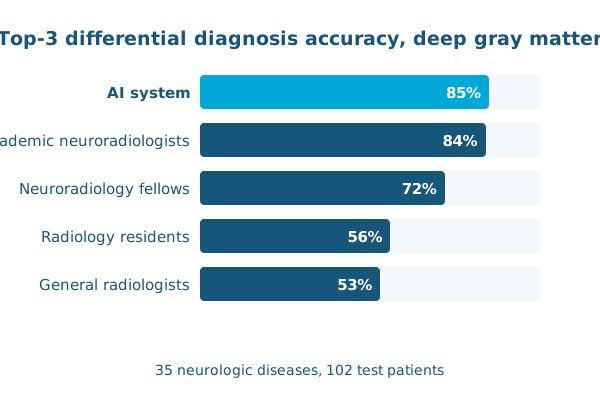
- The system’s top three diagnoses were correct 85% of the time, better than radiology residents (56%), general radiologists (53%) and neuroradiology fellows (72%), and not different from academic neuroradiologists (84%).
Because it reports disease burden, interpretable intermediate features and a probabilistic diagnosis together, this kind of system could support clinical decisions for common and rare diseases.
Reference: Rudie JD, Rauschecker AM, Xie L, et al., Mohan S, Gee JC. Subspecialty-level deep gray matter differential diagnoses with deep learning and Bayesian networks on clinical brain MRI: a pilot study. Radiology: Artificial Intelligence. 2020. doi:10.1148/ryai.2020190146