
An AI system approaching neuroradiologist-level diagnosis on brain MRI

Artificial intelligence (AI) shows promise across radiology, but had not been shown to generate differential diagnoses for both common and rare diseases on brain MRI.
In Radiology, Andreas Rauschecker, Jeffrey Rudie, Long Xie, Jiancong Wang, Tessa Cook, Jim Gee and colleagues tested an AI system that combines data-driven and expert-knowledge methods:
- Deep learning detects lesions.
- Atlas-based registration and segmentation extract 18 quantitative imaging features.
- Bayesian inference combines the imaging features with five clinical features to produce a probability-ranked differential diagnosis.
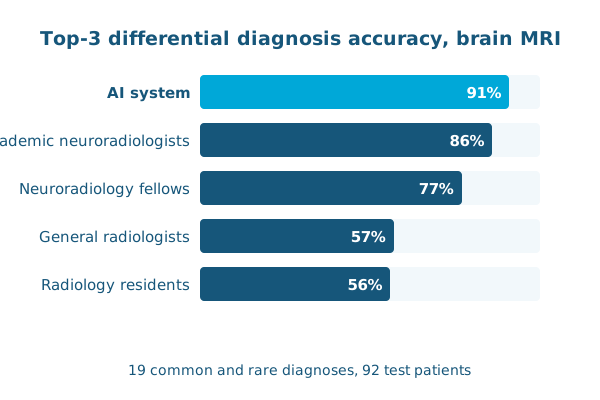
In 92 independent test patients with 19 common and rare diagnoses, the AI system’s top three diagnoses were correct 91% of the time. That was similar to academic neuroradiologists (86%) and better than radiology residents (56%), general radiologists (57%) and neuroradiology fellows (77%). Unlike the radiologists, who were much more accurate for common than for rare diseases, the AI system’s accuracy did not depend on how common the disease was.
Reference: Rauschecker AM, Rudie JD, Xie L, et al., Mohan S, Gee JC. Artificial intelligence system approaching neuroradiologist-level differential diagnosis accuracy at brain MRI. Radiology. 2020. doi:10.1148/radiol.2020190283