
TransMatch: transformer-based feature matching for deformable registration

Deformable image registration depends on establishing correspondences between regions of two images. Traditional feature-based methods match features explicitly but iteratively, which can take minutes per registration. Learning-based methods such as VoxelMorph and TransMorph are fast and competitive, but they are typically single-stream: the two images are stacked into one input, and the correspondence between them is only learned implicitly.
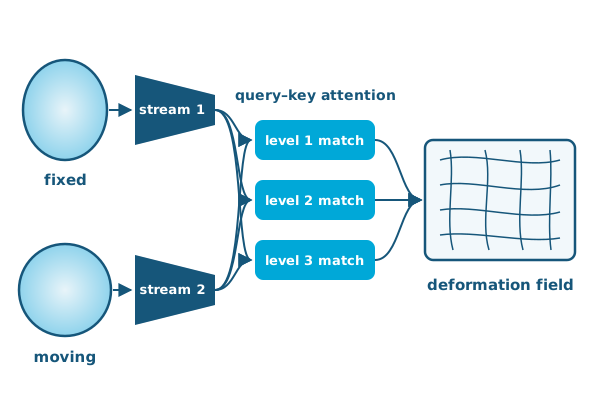
In IEEE Transactions on Medical Imaging, Zeyuan Chen, Yuanjie Zheng and Jim Gee introduce TransMatch, an end-to-end, unsupervised, dual-stream registration framework:
- Each image is processed by its own branch, which extracts features independently.
- Features are then matched explicitly between the two images at multiple levels, using the query-key matching idea from the Transformer’s self-attention mechanism.
On three 3D brain MRI datasets (LPBA40, IXI and OASIS), TransMatch achieved state-of-the-art performance on several metrics compared with widely used methods including SyN, NiftyReg, VoxelMorph, CycleMorph, ViT-V-Net and TransMorph.
Reference: Chen Z, Zheng Y, Gee JC. TransMatch: a transformer-based multilevel dual-stream feature matching network for unsupervised deformable image registration. IEEE Transactions on Medical Imaging. 2024. doi:10.1109/TMI.2023.3288136