
Predicting return to duty after blast-related mild TBI

Traumatic brain injury (TBI) has been called the signature injury of the wars in Iraq and Afghanistan, where improvised explosive devices made blast TBI a leading cause of injury.
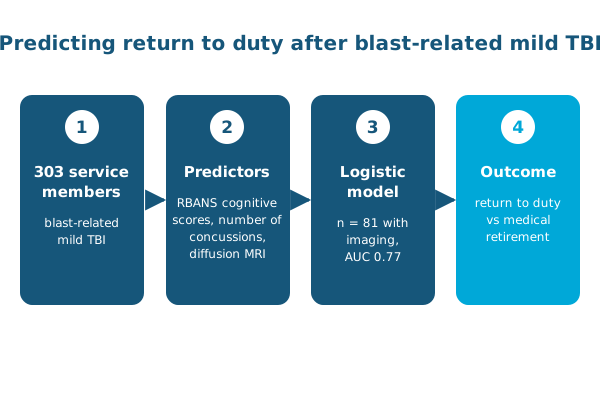
In the Journal of Neurotrauma, Philip Cook, Jim Gee and colleagues studied 303 service members with blast-related mild TBI treated at the Intrepid Spirit Concussion Recovery Center at Naval Medical Center Camp Lejeune. The goal was to predict who would return to duty and who would be medically retired, so that resources could be targeted to those less likely to recover through standard treatment.
- Higher scores on the Repeatable Battery for the Assessment of Neuropsychological Status (RBANS) were associated with returning to duty.
- A history of three or more lifetime concussions was associated with a lower chance of returning to duty.
- Elevated apparent diffusion coefficient in the anterior corona radiata, a diffusion MRI measure, was also associated with a lower chance, though it was not significant in the combined model.
A logistic regression model using these factors in 81 service members with imaging classified outcomes with an area under the ROC curve of 0.77. Cognitive testing and TBI history may help identify service members at risk of medical retirement.
Reference: Cook PA, Johnson TM, Martin SG, Gehrman PR, Bhatnagar S, Gee JC. A retrospective study of predictors of return to duty versus medical retirement in an active duty military population with blast-related mild traumatic brain injury. Journal of Neurotrauma. 2018. doi:10.1089/neu.2017.5141