
A roadmap for bringing machine learning into radiology practice

Despite rapid progress in machine learning (ML) for health care, few algorithms have made a real difference in day-to-day hospital medicine. The gap is often not the algorithm itself, but everything needed to put it into clinical use.
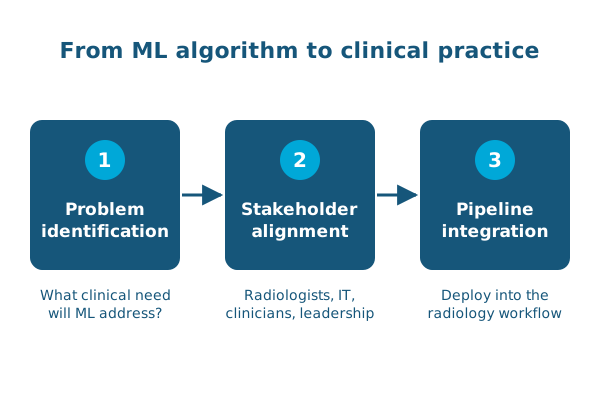
In a review in Radiology, Allison Chae, Michael Yao, Jeffrey Duda, Jim Gee and colleagues propose a standardized, step-by-step framework for implementing artificial intelligence in the clinical practice of radiology. The framework rests on three components:
- Problem identification: defining the clinical need the ML tool will address.
- Stakeholder alignment: bringing together the people who will build, run and use the tool.
- Pipeline integration: fitting the tool into existing imaging and clinical workflows.
Drawing on recent literature and on empirical experience with radiologic imaging applications, the review discusses how to structure implementation efforts so that other hospital practices can use ML to improve patient care.
Reference: Chae A, Yao MS, Sagreiya H, et al., Gee JC. Strategies for implementing machine learning algorithms in the clinical practice of radiology. Radiology. 2024. doi:10.1148/radiol.223170